Chapter 2: The Break-in Period — The Hidden Tuition
Thesis: Everything in this book only works after you and your workflow have co-adapted. Most people who conclude "parallel AI is hype" are stuck in Phase 1 of a four-phase break-in and don't know there are three more phases ahead.
What "break-in" means
Break a new pair of leather boots in and the first week hurts. Run a new engine for a thousand miles before you trust it at redline. Hire a senior engineer and expect three months before they're producing at their real level. In all three cases, the tool and the environment are co-adapting — the tool shaping to the task, the environment learning the tool's real edges.
AI agent workflows are the same. You don't install parallel development; you break into it. The residue of the break-in period — skills you've written, prompt templates you've refined, task-decomposition habits you've learned, failure modes you now know to avoid — is what makes the three keys in Chapters 3, 4, and 5 actually pay off. Without that residue, the mechanisms in those chapters are just words on a page.
This is the chapter most AI development books skip, because it's not flattering to sell. Everyone writes about the destination; almost no one writes about the road.
The four phases
The break-in isn't gradual in the sense of smooth. It has shape. Four phases, each with a distinct experience and a distinct signal for when you've moved on.
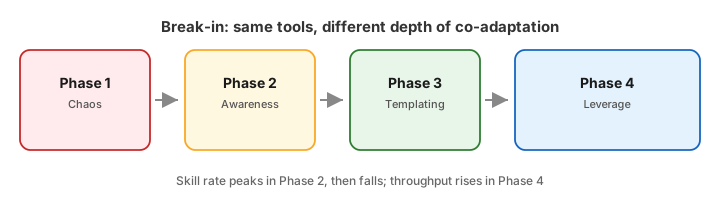
Phase 1: Chaos
What it feels like: You've read this book or something like it. You launch three agents at once. Within an hour, two of them have touched overlapping files, one has interpreted the requirement in a way you didn't intend, and you have three PRs to review that all need substantial rework. By the end of the day, you're more tired than if you'd written the code yourself, and the output is worse.
The conclusion people draw at this stage: "Parallel AI is hype. It doesn't work."
Why they're wrong: Every step of that disaster was predictable. You hadn't built the shared-context substrate (skills, AGENTS.md, architectural norms) that keeps three agents coherent. You hadn't written the test plans that would have caught the interpretation drift early. You hadn't picked orthogonal tasks that wouldn't collide. This isn't the workflow failing — it's you being a Phase 1 user of a Phase 4 workflow.
Signal you're leaving Phase 1: You start recognizing categories of failure instead of individual bugs. "Oh — the agent does this thing again where it invents a utility function when one already exists." Once you can name a failure mode, you can write a skill for it.
Phase 2: Awareness
What it feels like: You're still mostly running one agent at a time. But you've stopped reacting to each mistake individually. You're starting to notice that the agent keeps getting one particular thing wrong, or keeps making the same architectural guess, or keeps missing one kind of edge case. Your AGENTS.md grows. You write your first real skill — probably covering a specific class of mistake that cost you a lot in Phase 1.
Mitchell Hashimoto's My AI Adoption Journey is the clearest public account of this transition. He describes the earlier period as "excruciating" and a "period of inefficiency" — and credits his turnaround to engineering the harness: writing AGENTS.md files that encode constraints, using deterministic hooks to prevent recurring errors, and deliberately reproducing the agent's work by hand first to build the expertise needed to delegate it. His description of the transition ("the agents failed at architectural tasks, high-performance data structures, complex language-specific logic, forcing me to manually rewrite or fight the agent") is a textbook Phase 1 report. His fix is a textbook Phase 2 move.
What the work looks like: Less time typing, more time writing down rules. You feel like you're doing "less engineering," and that feels wrong, but the code quality starts climbing.
Signal you're leaving Phase 2: You start reusing skills across tasks without modification. The first time you invoke a skill you wrote two weeks ago on a new feature and it Just Works, you've moved on.
Phase 3: Templating
What it feels like: You have a working playbook. Requirement alignment follows a shape you recognize. Test plans come out looking roughly similar in structure. Code review, when you do it, checks the same handful of things the skills should have already covered. You might have two agents running at once regularly now, usually on tasks you deliberately picked because they don't collide.
What the work looks like: New skills still get written, but the rate is slowing. You're no longer finding new categories of mistakes; you're refining the skills you have.
Signal you're leaving Phase 3: You start successfully running more than three agents concurrently on non-trivial work, and you don't spend the whole day context-switching. The scheduling patterns in Chapter 7 start feeling natural rather than effortful.
Harper Reed's My LLM codegen workflow atm — written in Feb 2025, ancestral to the current 2026 Plan Mode / SDD convention — is a public Phase 3 artifact from the previous practice era. What he published was not a clever trick; it was a template distilled from enough projects to know its shape. That's what Phase 3 looks like on the outside — you start being able to write down your own workflow because it has stabilized enough to be describable. (The current 2026 replacement — Chapter 3's Plan Mode + SDD shape — is the same pattern with verification contracts added; it didn't exist when Reed wrote his post.)
Phase 4: Leverage
What it feels like: The three keys run on autopilot for most work. Parallel agents produce code in a consistent style. You spend most of your time on requirement alignment and high-level judgment, not execution. When you read tech Twitter claiming "AI doesn't work for real dev," you know they're not lying — they're just describing Phase 1.
Cherny's shared monthly totals — 259 PRs, 497 commits, 40k lines added and 38k lines removed, all generated by Claude Code, across 1.6k sessions totaling roughly 325 million tokens in thirty days — is what Phase 4 output looks like from the outside. Most of the information in that paragraph is not how much he shipped; it's how much he removed. You don't delete 38k lines on accident. You delete them because, at Phase 4, you have the throughput to actually clean up what was already there, on top of shipping the new features.
What you can do here that you couldn't do earlier: best-of-N as a default (Chapter 6), agent-internal parallelism (Chapter 7 mode 4), and — honestly — taking on work that would have been too ambitious for a solo engineer. This is the leverage the book is actually selling.
The trap of Phase 4: You forget the break-in. You recommend the workflow to a friend, they land in Phase 1 overnight, and they conclude you were lying.
How long each phase takes
There is no honest universal answer. Factors that dominate:
- Codebase maturity. A codebase with strong conventions, good tests, and a clear module structure shortens every phase.
- How much you write down. Phase 2 is essentially "writing things down." Engineers who default to verbal knowledge transfer move through it slowly.
- Tool churn. Every time you switch primary agent (Cursor → Claude Code → Codex), you reset somewhere between a full phase and a half.
- Team size. A solo developer moves faster through early phases; a team plateaus until the shared skills are written down for everyone.
My rough calibration, and I want to be honest that this is calibration, not measurement: most solo engineers reach Phase 3 with one codebase they care about. Fewer reach Phase 4. Teams reach Phase 4 with a codebase only when someone has explicitly invested in writing skills as a shared asset.
What to measure
You can't manage what you don't measure. The cheapest break-in-phase metric I know of is new-skill-per-week rate on a codebase you work on seriously:
- Phase 1: zero (you don't know what to write yet)
- Phase 2: 2–5 per week (the floodgates open)
- Phase 3: declining, from 2/week toward <1/week
- Phase 4: near zero on steady state; brief spikes when you touch a new subsystem
When the rate drops near zero and you're shipping cleanly, you're in Phase 4. When the rate drops near zero and you're shipping poorly, you've stopped paying attention.
A secondary signal: the ratio of time spent on requirement alignment to time spent on review. In Phase 1, review dominates because you don't trust the output. In Phase 4, alignment dominates because review is mostly automated. The crossover usually happens somewhere in late Phase 2.
How the Opus 4.5 "inflection" actually works
Chapter 1 hedged carefully about the "late 2025 capability jump." The break-in framework explains the hedge.
Model capability raises the ceiling of what Phase 4 can do. It does not shorten Phase 1, Phase 2, or Phase 3 for you. This is why the same model release looks world-changing to one engineer and unremarkable to another. The one who already had a skill library, a test-plan habit, and a worktree-based workflow got more leverage from the better model. The one who'd been typing prompts into a single chat window got a slightly smarter chat window.
The model raises the ceiling. The break-in determines how close to the ceiling you actually live.
Skills as residue, not recipes
One subtle implication of the break-in frame: skills are not a library you download; they are the fossil record of your break-in period.
A skill that encodes a generic engineering principle — "prefer composition over inheritance," say — is close to useless. An agent already knows that. A skill that encodes "in this codebase, background jobs are defined in jobs/*.ts and must have a corresponding retry policy defined in jobs/retries.ts, and the agent keeps forgetting the second part" — that one is gold, because it's specific to your scar tissue.
This is why copying someone else's AGENTS.md wholesale rarely works. Their scar tissue isn't yours. The forty lines of hard-won specificity that make their workflow run are specific to their codebase, their tools, and the mistakes their agent made twice before they codified it. You can steal the shape of their skills file, but the content has to be yours.
Chapter 5 treats this more formally. For now, the point is: your skill library is the visible evidence of how far you've broken in.
Advice by phase
Since every reader is at a different phase, the rest of this book's advice is not uniform. A partial map:
- If you're in Phase 1: don't try to run more than one agent at a time. Pick small, well-scoped tasks. When something goes wrong, resist the urge to fix it by typing the code yourself — instead, write down why it went wrong. That note is your first skill.
- If you're in Phase 2: the three keys (Chapters 3, 4, 5) are for you. Start with Key #2 (test plans), because it pays back fastest on a single-agent workflow.
- If you're in Phase 3: Chapter 7's modes 2 and 3 are for you. You have enough discipline to run two or three agents concurrently on orthogonal work. Don't reach for mode 4 yet.
- If you're in Phase 4: Chapter 6 (cheap failure / best-of-N) is where the real leverage is. Also: you are now a teacher, whether you wanted to be or not. The most common mistake at this phase is confusing your current capability with the baseline everyone else has.
The tuition metaphor
The break-in period is a tuition. You pay it by spending attention on tasks you could have done faster yourself, watching the agent fail in ways you'd never have failed, and writing down what you saw. There is no refund, there is no accelerator. The only variable is whether you notice you're paying tuition — and keep the receipts (the skills) — or whether you conclude the school is bad and drop out.
Everyone pays the tuition. The ones who succeed are the ones who treat the receipts as the asset.
External voices
- Supporting — break-in chronicled, in public: Simon Willison's ai-assisted-programming tag archive is close to a real-time record of one engineer breaking in, explicitly revising prior positions as his tooling and skills matured. His Embracing the parallel coding agent lifestyle (Oct 2025) opens by saying he spent months skeptical of the parallel pattern before adopting it — a clean example of moving from Phase 1/2 to Phase 3.
- Supporting — "it was excruciating": Mitchell Hashimoto's My AI Adoption Journey is the most direct "break-in memoir" in this genre. He describes the initial phase as "excruciating" and a "period of inefficiency," and explicitly credits the turnaround to engineering his own harness —
AGENTS.mdfiles, deterministic tools, hooks — which is exactly the Phase 2 → Phase 3 transition this chapter describes. His follow-up Vibing a Non-Trivial Ghostty Feature is an honest account of a Phase 4 run with costs disclosed. - Challenging — the skeptic-turned-convert genre: Max Woolf's detailed skeptic-tries-agents post, summarized by Simon Willison as An AI agent coding skeptic tries AI agent coding, in excessive detail, is worth reading in full. Woolf's early frustration reads as Phase 1; his later adjustments are the beginning of Phase 2. Most "AI coding doesn't work" posts are this same shape caught earlier in the arc.
- Challenging — is the break-in actually climbable?: Marc Nuri's The Missing Levels of AI-Assisted Development describes the jump from one agent to many as a discontinuity, not a smooth curve. This is compatible with the four-phase model if you read the "missing level" as the skill-library substrate — without it, the jump is indeed a drop, not a step.
What's next
Chapter 3 begins Part III with Key #1: requirement alignment. The one step in the whole workflow that genuinely cannot be parallelized.